
"Can AI create character-related infographics?" someone asked me a while back.
"Absolutely! I'll make a tutorial for that," I replied. Well, that took longer than expected.
Now that Nano Banana Pro is here, it's the perfect tool for this job—and the results are even better than I imagined. Today, I'm sharing my hands-on experience creating stunning character infographics.
Whether you're preparing materials for work presentations or classroom teaching, these infographics will instantly impress your colleagues, students, or clients.
This guide is packed with practical value—bookmark it now!
Part 1: Academic Character Infographics
When studying various subjects, knowledge about famous figures is often scattered and hard to remember. Using Nano Banana Pro to generate character infographics consolidates all that information into a visually engaging format that's much easier to understand.
Below are several battle-tested prompts covering literature, mathematics, history, and science. Each prompt is precisely tailored to match the subject's characteristics and the figure's unique qualities.
1. Literature: William Shakespeare
Background: The English playwright and poet whose mastery of language and complex character development reached unprecedented heights. He excelled at exploring power, desire, fate, and the shadows of human nature—both grand and intimate.
Aesthetic Match: Renaissance copper-engraving + parchment manuscript + theater woodgrain structure (perfectly captures the Elizabethan era atmosphere).
Prompt:
A detailed character infographic of William Shakespeare, aspect ratio 9:16, in a Renaissance copper-engraving + parchment-manuscript aesthetic. Dense etched linework combined with aged paper texture.

Center: A classic half-body portrait of Shakespeare in Elizabethan attire (ruff collar, dark coat), with a wise gaze and a hint of theatrical irony. His right hand holds a feather quill, his left hand lightly rests on an open play script. Framed inside a bas-relief frame combining laurel leaves + quill motifs (antique metal mixed with warm wood grain).

Layout details:
Top row: A lineup of Shakespeare head design sheets showing different emotional expressions (contemplative, sarcastic, compassionate, cold stare), each with a small caption keyword beside it.
Left column: A section titled "Archive of the Stage Soul", background decorated with parchment drafts, ink stains, and revision marks. Include official profile info such as name, era, major genres (tragedy/comedy/history), language style, and core themes. Typography mixes classic calligraphy with handwritten notes.
Right column: A section titled "Allies of Fate on the Stage", using ticket-collage + woodcut illustration style to present key characters (name mapping): Hamlet (skull and soliloquy), Macbeth (crown and dagger), Othello (shadow of jealousy).
Bottom area: A "key items / equipment breakdown" in museum exhibit label style. Display separately: quill + ink bottle, a miniature wooden model of the Globe Theatre, and a scroll-like sonnet manuscript.

Overall palette: ivory white, deep brown, antique gold, and ink black; fine engraving lines; worn poster-like texture with strong dramatic tension.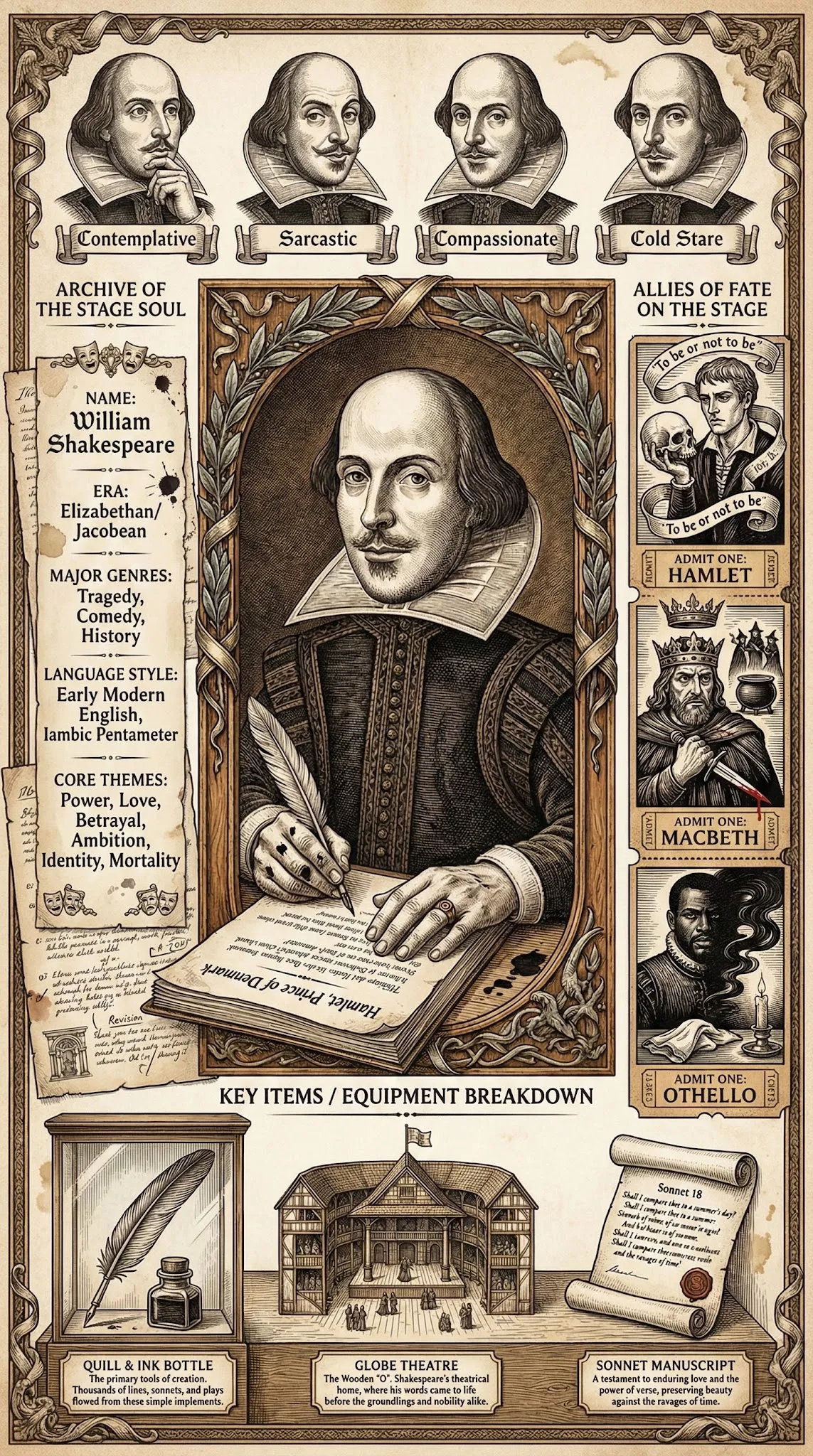
2. Mathematics: Leonhard Euler
Background: The most prolific "formula machine" in mathematical history, spanning analysis, number theory, geometry, and mechanics. His style is defined by clarity, systematization, and computability.
Aesthetic Match: Engineering blueprint + chalkboard formulas + brass instruments (captures Euler's systematic and structural approach).
Prompt:
A detailed character infographic of Leonhard Euler, aspect ratio 9:16, in a hybrid engineering blueprint + chalkboard formula aesthetic. Precise technical linework with clearly readable equations and geometric constructions.

Center: A classic half-body portrait of Euler in 18th-century scholar attire (dark robe, white collar), gentle and focused. His right hand holds chalk pointing toward floating formula structures, while his left hand carries a thick mathematical manuscript. Framed inside a precision frame made of brass compasses, protractors, and gears.

Layout details:
Top row: A lineup of Euler head design sheets showing different expressions (deep focus, sudden inspiration, rigorous verification, exhausted but determined).
Left column: A section titled "Formula Workshop Attributes", background decorated with grid paper, coordinate axes, and function curves. Include official profile info: name, era, signature symbols/contributions (e, graph theory/Eulerian path, analytic methods, etc.), and style tags (clear/systematic/high-output). Typography uses copperplate print.
Right column: A section titled "Constellation of Minds", presenting key figures in blueprint line-drawing style (name mapping): Newton (mechanics and light), Bernoulli (family and fluid), Lagrange (analysis and structure).
Bottom area: A "key items / equipment breakdown" in engineering catalog style. Display separately: a plaque of the Euler identity "e^{iπ}+1=0", a geometric polyhedron model, and a parchment sheet filled with derivations plus a chalk box.

Overall palette: Prussian blue, ivory white, chalkboard gray, and antique brass; ultra-fine lines; strict annotations; an elegant rational mood with an engineering-level precision.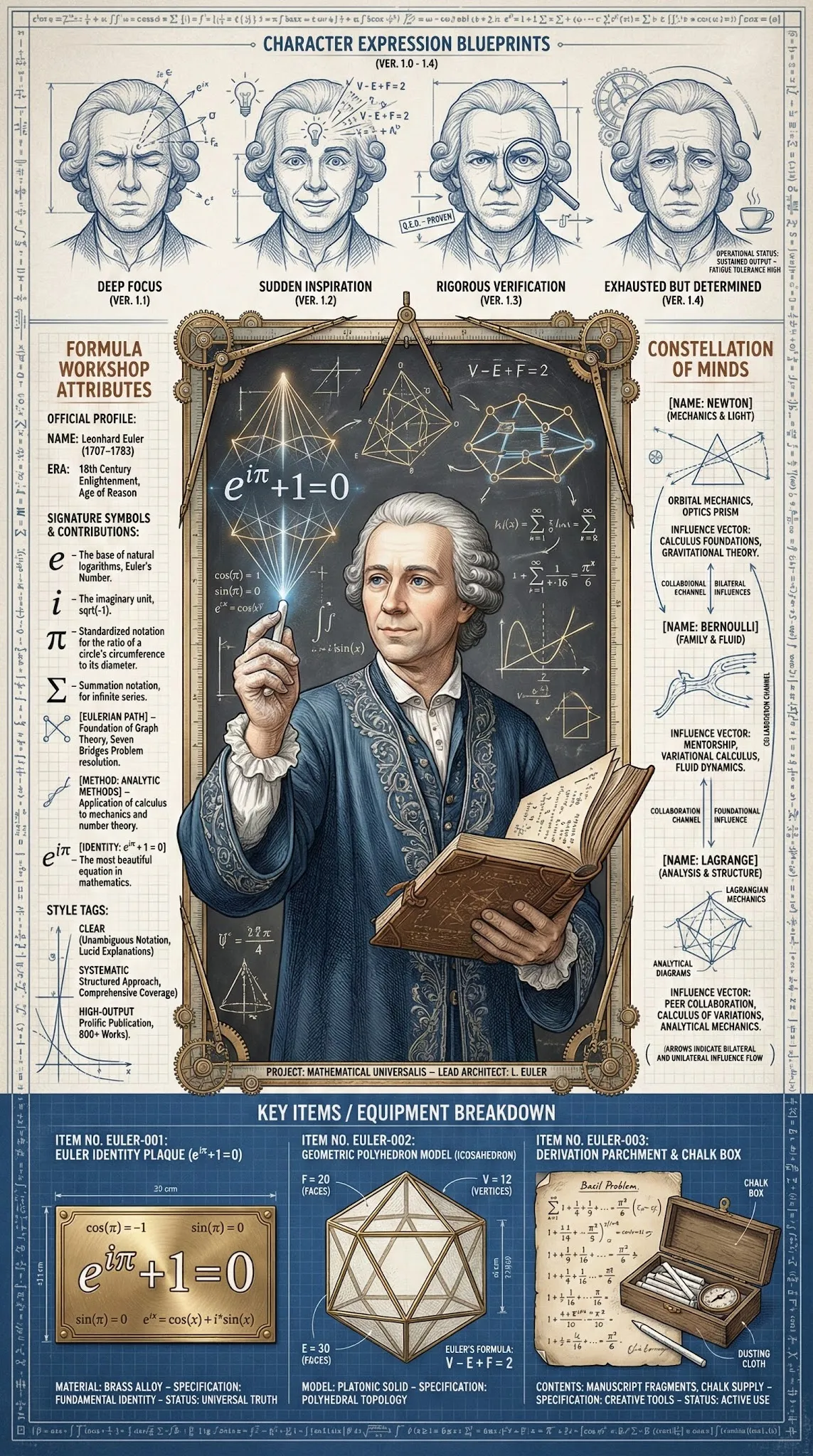
3. History: Napoleon Bonaparte
Background: The ultimate example of weaving war, politics, institutions, and personal ambition into one narrative. Key image attributes: strategy, speed, order, and imperial grandeur.
Aesthetic Match: Epic oil-painting + military map textures + imperial emblems (golden eagle, laurel, medals).
Prompt:
A detailed character infographic of Napoleon Bonaparte, aspect ratio 9:16, in a black-gold epic oil-painting + military map collage aesthetic. Grand, solemn composition with strong dramatic lighting.

Center: A classic full-body portrait of Napoleon in imperial military uniform (dark blue coat, gold epaulettes and medals). One hand presses on a military map, the other holds a folding spyglass or command baton. Expression is calm, sharp, and driven. Framed inside a heavy metal frame made of an imperial eagle emblem + laurel wreath + medal chain motifs, with slight worn edges.

Layout details:
Top row: A lineup of Napoleon head design sheets showing different expressions (ambition, battlefield assessment, anger, restrained contemplation).
Left column: A section titled "Imperial Command Record", background decorated with aged military maps, compass lines, and marching arrows. Include official profile info: name, era, core legacy tags (tactics/reform/codification), personality keywords (speed/order/ambition), and title settings. Typography uses classic serif with military dossier layout.
Right column: A section titled "Opponents & Allies on the Chessboard of an Era", using battle-report clippings + heraldic badge style to present key figures (name mapping): Wellington (coalition commander), Talleyrand (diplomacy and intrigue), Joséphine (emotion and court).
Bottom area: A "key items / equipment breakdown" in museum exhibit label style. Display separately: bicorne hat + medals, the cover of the French Civil Code (Napoleonic Code), an imperial eagle banner, and a miniature cannon model.

Overall palette: black, dark gold, deep navy, with blood-red accents; heavy strokes and thick texture; atmosphere of war fog + imperial glow.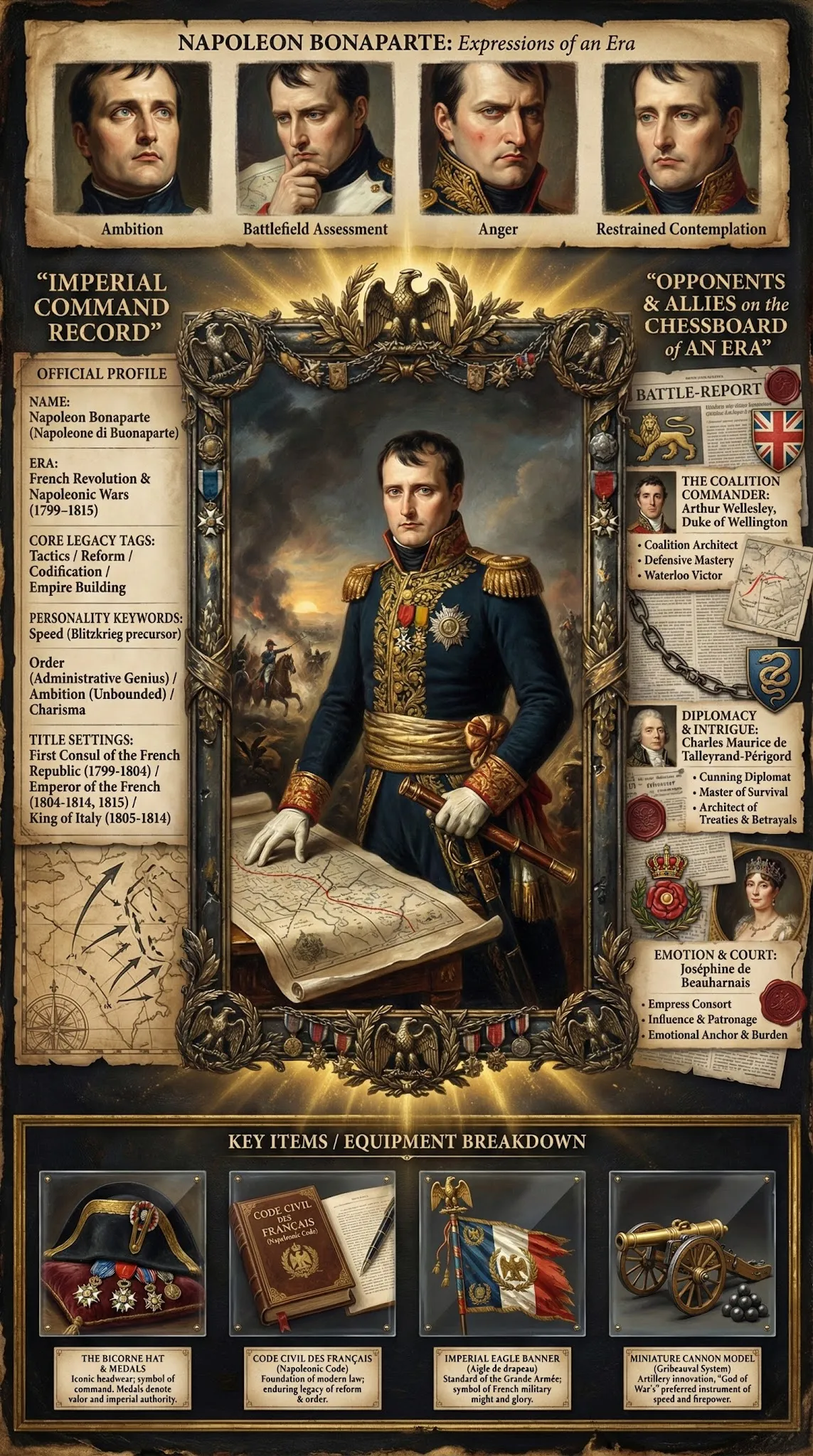
4. Physics: Albert Einstein
After the weight of history, let's unlock physics' playful genius—Einstein. He revolutionized our understanding of the universe while maintaining a humorous and casual demeanor.
Using a Sanrio picture-book style with warped space-geometry frames highlights his scientific achievements while making this scientific giant more approachable and relatable.
Prompt:
A detailed character infographic of Albert Einstein, aspect ratio 9:16, in a Sanrio-style cute picture-book aesthetic.

Center: A classic half-body portrait of Einstein wearing his signature messy sweater, with a mischievous, childlike expression sticking out his tongue. Placed inside a warped space-geometry frame.

Layout details:
Top row: A lineup of Einstein head design sheets showing different emotional variations (curious, confused, ecstatic, serene).
Left column: A section titled "Cosmic Observer", with a background decorated with atomic structure diagrams and speed-of-light streak lines. Include official profile info such as name, birthplace, relativity, Nobel Prize, etc. Typography uses a chalk handwritten style.
Right column: A section titled "Spacetime Bonds", presenting key figures in a gemstone projection style (name mapping): Planck (father of quantum theory), Bohr (fated rival), Mileva (first wife).
Bottom area: A breakdown of key items / equipment in a futuristic laboratory style. Display separately: a glowing "E=mc²" light sign, an old violin, and a smoking pipe.

Overall palette: cosmic purple, neon green, and deep-space black; rounded, dynamic linework.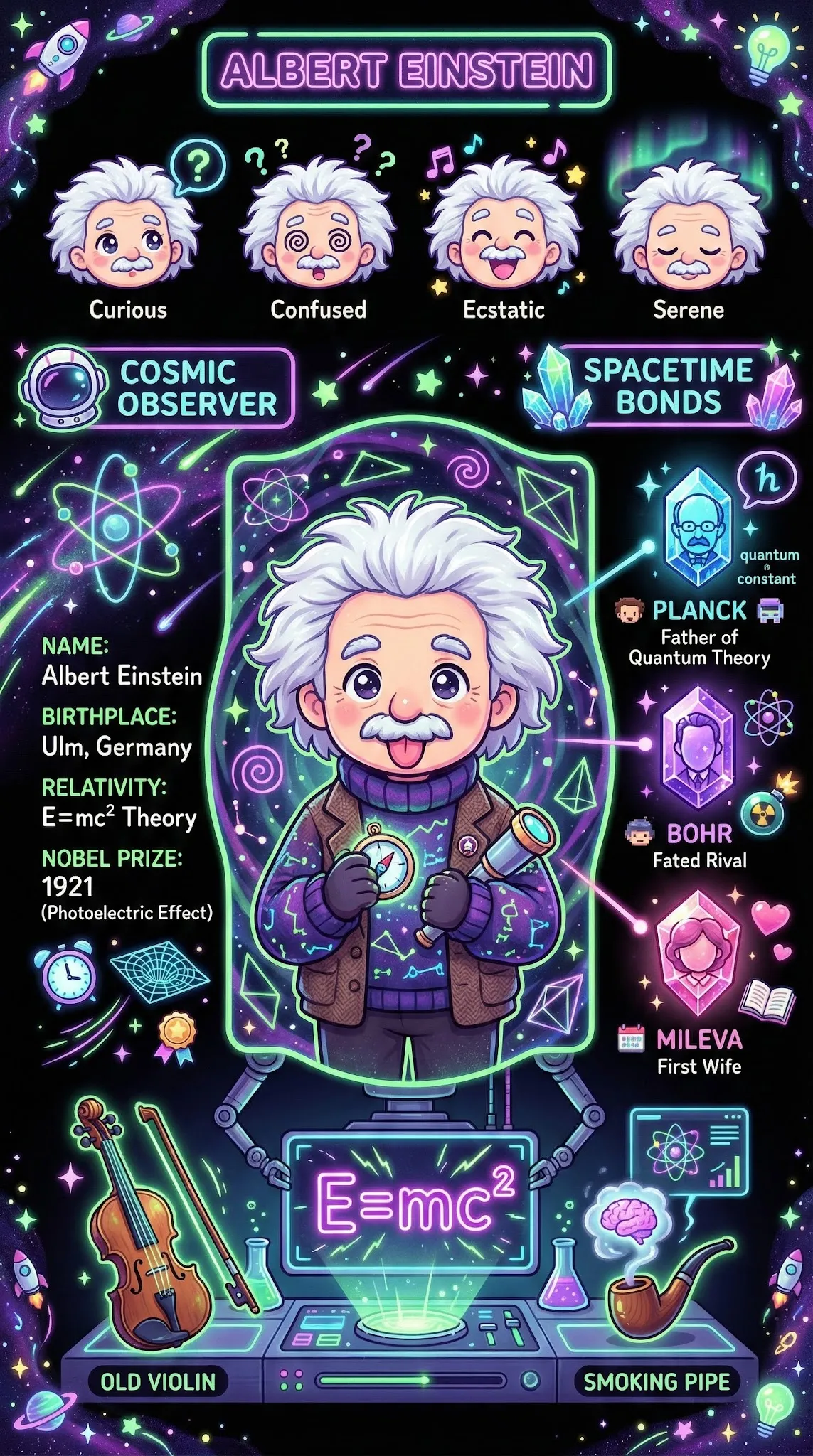
5. Chemistry: Dmitri Mendeleev
The chemistry pioneer who made history with the periodic table, spending his life among test tubes and reagents in the laboratory.
American cartoon style with a test-tube frame perfectly captures his wild focus at the lab bench—the atmosphere is off the charts.
Prompt:
A detailed character infographic of Dmitri Mendeleev, aspect ratio 9:16, in an American cartoon aesthetic.

Center: A classic half-body portrait of Mendeleev wearing a lab coat stained with chemical reagents, with his iconic big beard and a wild yet intensely focused expression. Placed inside a glass frame assembled from countless interconnected test tubes.

Layout details:
Top row: A lineup of Mendeleev head design sheets showing different emotional variations (dream-born inspiration, shock, sternness, satisfaction).
Left column: A section titled "Element Creator", with a background decorated with molecular ball-and-stick models. Include official profile info such as name, discovery date, element 101, predictive ability, etc. Typography uses a typewriter font.
Right column: A section titled "Heirs of Alchemy", presenting key figures: Lavoisier (god of the balance), Boyle (master of pressure), Marie Curie (fluorescent apparition).
Bottom area: A breakdown of key items / equipment in a game-item compendium style. Display separately: a long scroll of the periodic table, a Bunsen burner, and a flask filled with gallium.

Overall palette: lake green, amber, and metallic gray; crisp, neat linework.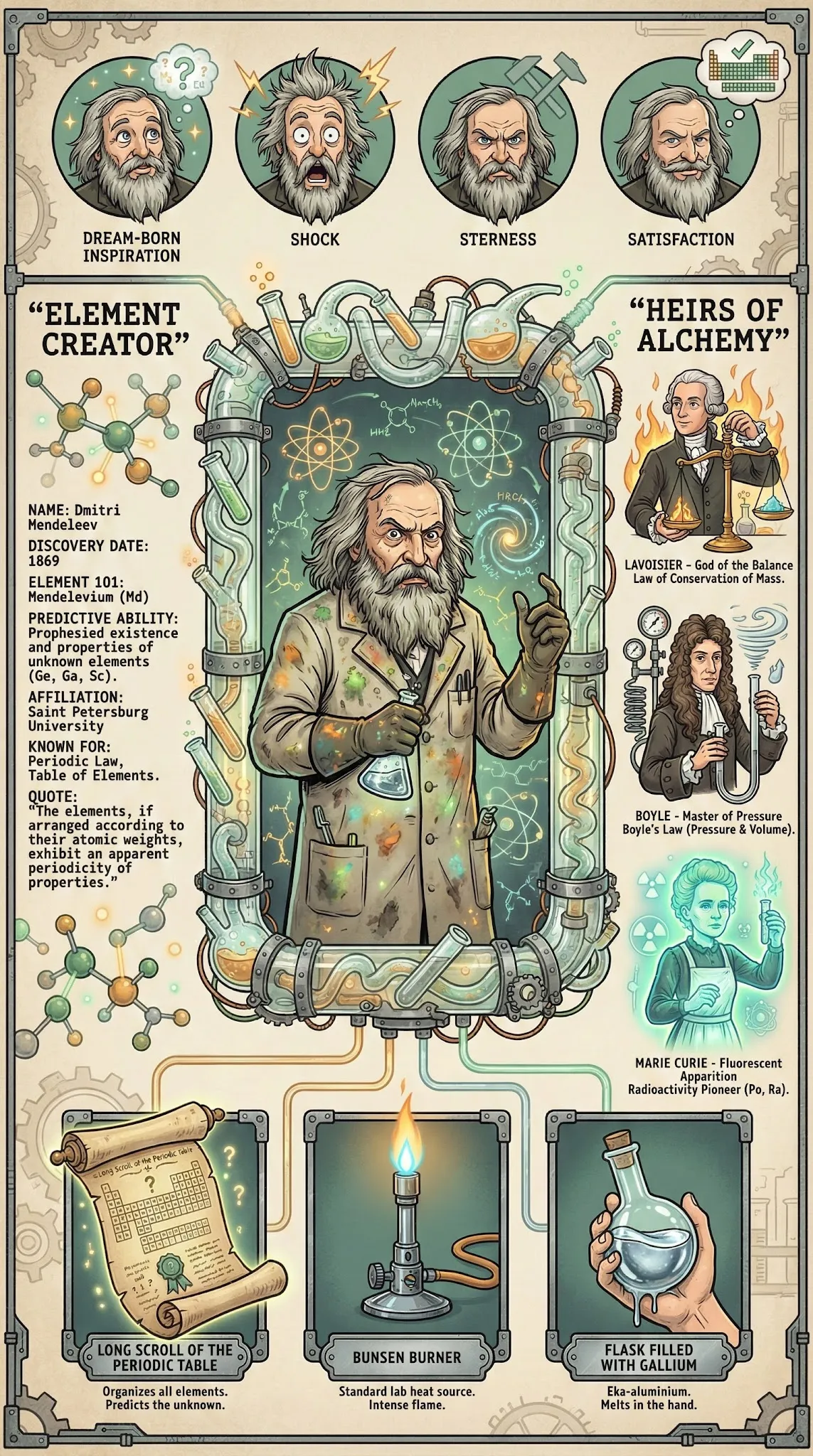
6. Biology: Gregor Mendel
Finally, let's step into the vibrant world of biology with the father of genetics—Mendel. His story is intertwined with peas and monastery gardens, filled with pastoral warmth rather than cold laboratory sterility.
Woodland picture-book style with a fresh flower frame perfectly matches his quiet dedication to research.
Prompt:
A detailed character infographic of Gregor Mendel, aspect ratio 9:16, in a woodland picture-book aesthetic.

Center: A classic full-body portrait of Mendel wearing monastery clerical robes, squatting in a monastery vegetable garden to observe pea plants, with a kind and patient expression. Placed inside a frame woven from fresh flowers.

Layout details:
Top row: A lineup of Mendel head design sheets showing different emotional variations (observing, recording, delighted, thinking).
Left column: A section titled "Foundation of Genetics", with a background decorated with pea-petal patterns. Include official profile info such as name, clergy role, law of segregation, law of independent assortment, etc. Typography uses an elegant script style.
Right column: A section titled "Genetic Lineage", presenting key figures: Morgan (fruit-fly emperor), Watson & Crick (double-helix duo), Darwin (giant of evolution).
Bottom area: A breakdown of key items / equipment in a laboratory specimen-collection style. Display separately: a bag of hybrid pea seeds, a pair of gardening shears, and a hand-drawn trait record notebook.

Overall palette: tender leaf green, earthy brown, and petal pink; rounded, soft linework with watercolor paper texture.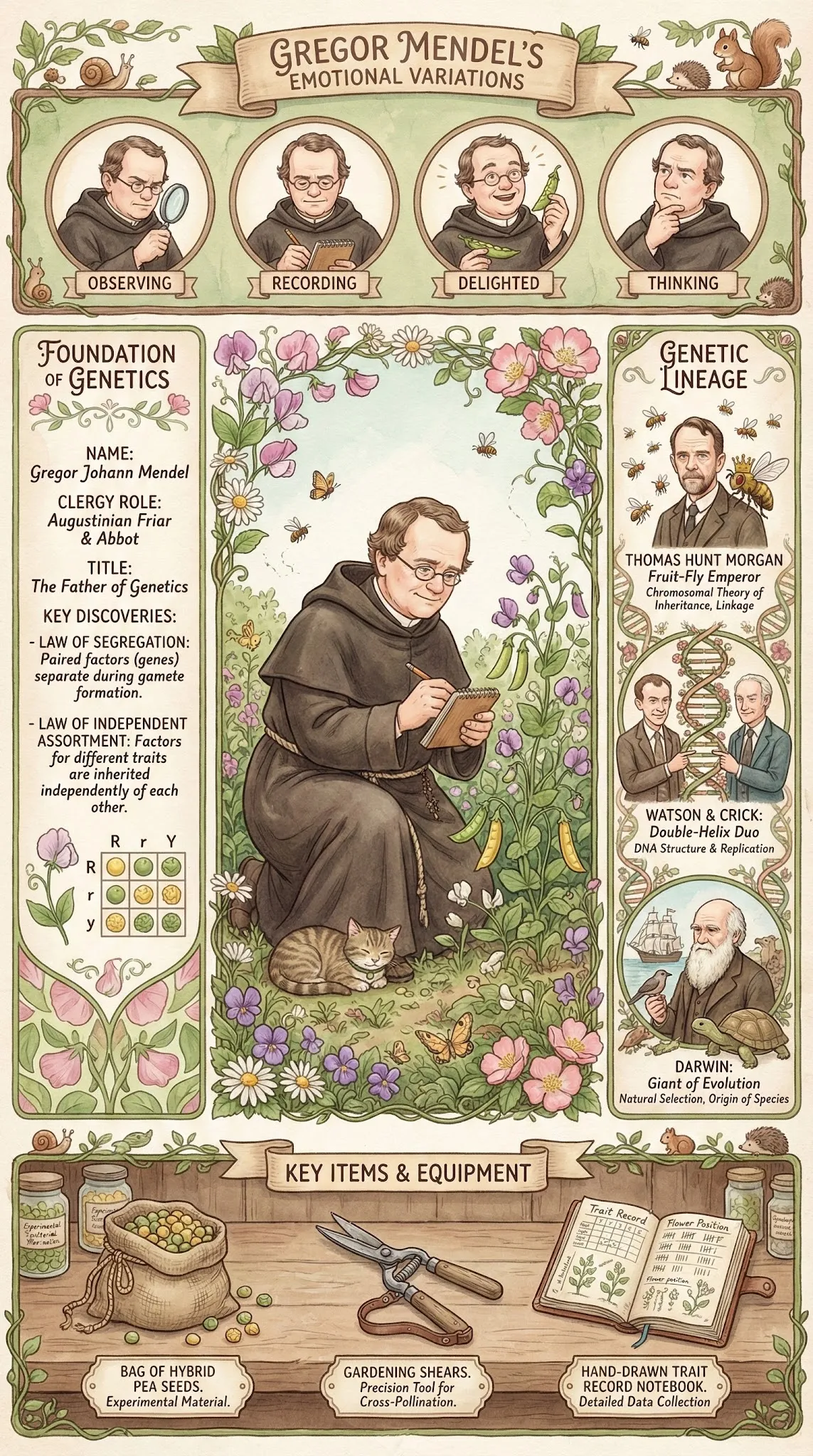
For more techniques on creating educational visuals, check out our guide on AI image parameters for beginners.
Part 2: Fictional Characters & Personal IP Infographics
Think we're done? Not even close!
Nano Banana Pro excels equally at fictional character creation and personal IP branding. Here are two extended examples—one for a popular novel character, and one for personal branding. Ready to copy these templates!
1. Fictional Character: Harry Potter
Let's use everyone's favorite wizard as our example.
Prompt:
A detailed character infographic of Harry Potter, aspect ratio 9:16, in a modern fantasy + wizarding parchment aesthetic. Mix magical ink, subtle celestial glow, and worn paper textures; clean but richly layered composition.

Center: A classic full-body portrait of Harry Potter in Hogwarts uniform (black robe, white shirt, tie), round glasses, messy black hair, with a calm but determined expression. He holds a wand in his right hand with a faint spell glow, and a small leather-bound book in his left hand. Framed inside an ornate "wand + lightning-bolt + owl feather" magical frame, with floating rune particles around the edges.

Layout details:
Top row: A lineup of Harry head design sheets showing different expressions (focused, brave, anxious, quietly hopeful). Each head has a small labeled tag beside it (e.g., FOCUS / COURAGE / FEAR / HOPE).
Left column: A section titled "Wizard Profile" with a background of faint Marauder's Map lines, parchment folds, and ink footprints. Include official profile info such as: Name, House, Core Traits, Signature Abilities, Patronus, and "Story Arc Keywords" (chosen one / friendship / sacrifice). Typography: elegant serif + handwritten ink notes, like a magical dossier.
Right column: A section titled "Bonds & Allies" presented in a scrapbook collage style (polaroid frames + torn parchment edges). Key characters (name mapping): Hermione Granger (books and brilliance), Ron Weasley (loyalty and chess), Albus Dumbledore (wisdom and phoenix). Add tiny icon badges next to each name.

Bottom area: A "key items / artifacts breakdown" in a museum exhibit label style. Display separately: Harry's wand, the Golden Snitch, the Invisibility Cloak (folded fabric texture), and a pair of round glasses as an iconic relic. Each item includes a small caption plate with a short descriptor.

Overall palette: midnight blue, parchment ivory, deep black, and warm gold highlights; sharp clean linework with subtle magical glow; lightly worn poster texture, cinematic and heroic mood.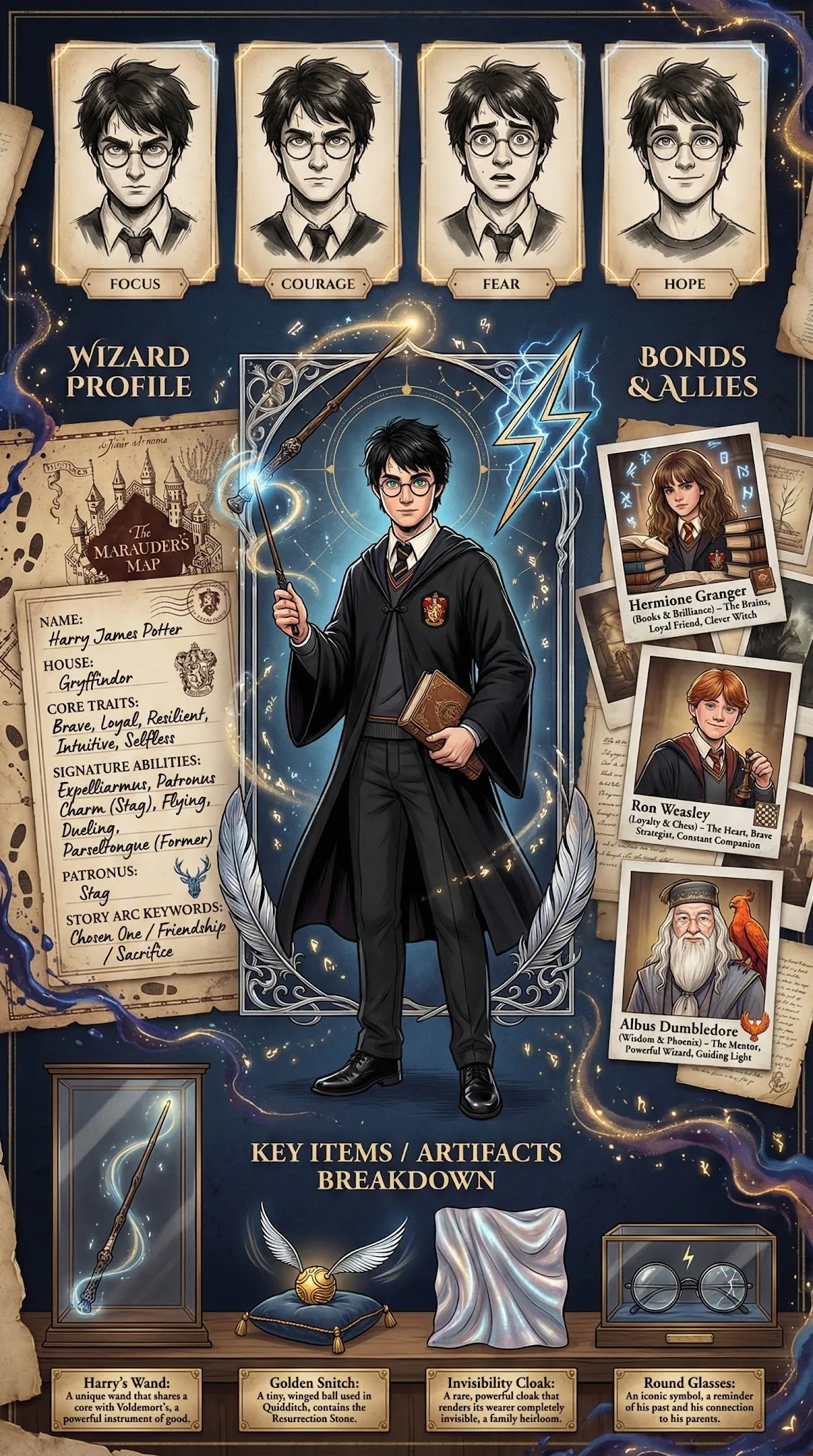
Want to create more fictional character art? Read our comprehensive guide on AI comic books and graphic novels.
2. Personal IP Branding
Now for a personal branding example. As an AI tools and indie development content creator, the core positioning is "professional, down-to-earth, and energetic."
Using a minimalist tech style with code-stream borders and circuit backgrounds highlights the AI creator identity while maintaining approachability—instantly memorable.
Simply upload your avatar and use a similar prompt structure:
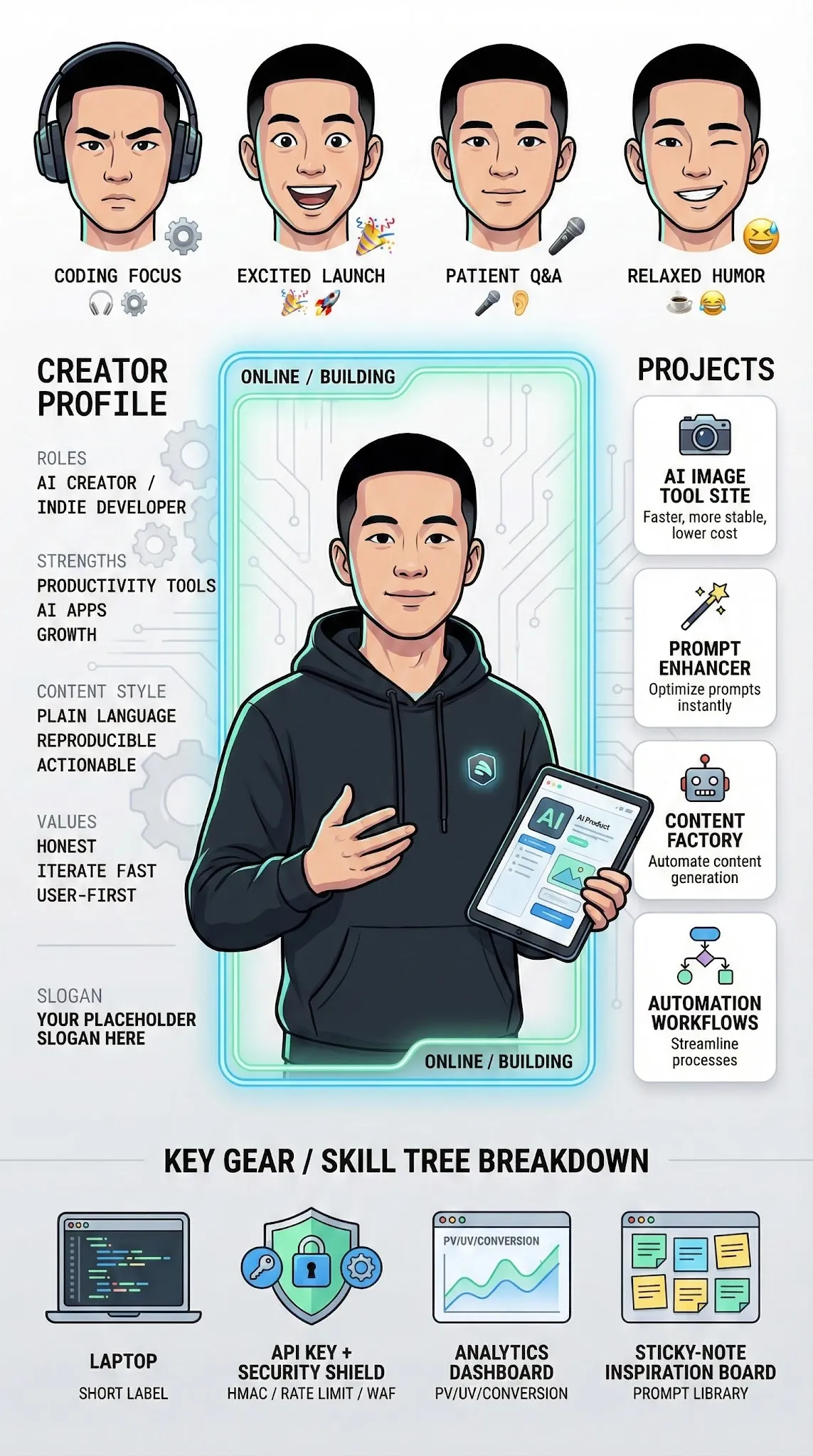
The result speaks for itself—absolutely nailed it!
Key Takeaways
Even though I had high expectations for Nano Banana Pro's image generation capabilities, I was genuinely surprised when I created my first character infographic.
The information density. The quality. Unmatched.
AI-powered education can achieve remarkable results through image generation—just like today's tutorial. When students have corresponding character infographics during their studies, it enriches their understanding from multiple angles and significantly boosts engagement.
Transforming thin textbook content into rich visual materials makes the learning experience more tangible and memorable.
This approach isn't limited to historical figures either. Whether you're designing fictional characters or building a personal brand, the same techniques apply beautifully.
Taking it further: Classic film characters, iconic anime figures, and beloved book characters can all be brought to life using these methods. My tests show excellent results across the board—give it a try yourself!
Start Creating Your Own Infographics
Ready to create stunning character infographics? Try Nano Banana Pro on Oh My Images with our generous free credits and see what you can create.
For more advanced prompting techniques, check out our prompt engineering guide for AI artists and our recent deep-dive on 10 pro-level hidden techniques for Nano Banana Pro.
Join our community to share your creations and get inspiration:
- Discord Community - Share your infographics and get feedback
- Follow us on X - Daily AI tips and inspiration
If you found this helpful, don't forget to bookmark and share with friends who could benefit from these techniques!